
It’s not the CMS. It’s how you manage your website as a service.
A website’s value to the business can grow faster than the teams that support it.

I started Midday to give practical support to people whose digital roles have grown and become harder to manage.
I’ve managed client websites for decades. In the early days, I did it all—designing and building features, updating content, and handling SEO. Back then, websites were relatively static. You built them, you launched them, and you handed them over.
Today, in mid-sized and large organisations, you’re managing an entire platform.
You’re in charge of technical support, data, content, SEO, and more. Your platform supports campaigns, leads, and compliance. There’s always something new, like a tracking update, a performance drop, or a third-party integration, that ends up on your desk.
Your stakeholders see the “front door,” but you see the “engine room.”
Behind the scenes, you know a script can slow down the site, and changing a form can break a workflow. Your stakeholders see the “front door,” but you see the “engine room.” That awareness protects the business, but it also means you carry the risk.
When expectations for website performance aren’t clear, and something goes wrong, the Content Management System usually gets the blame.
The website has grown beyond its original purpose.
Sometimes the platform is at fault. More often, though, the website has grown beyond its original purpose. Research shows many digital initiatives fail not because of the technology itself, but because operating models and decision rights are unclear (McKinsey & Co., Why Digital Strategies Fail). If your site feels unstable, it’s time to ask yourself:
Who is actually responsible for running the Website as a Service?
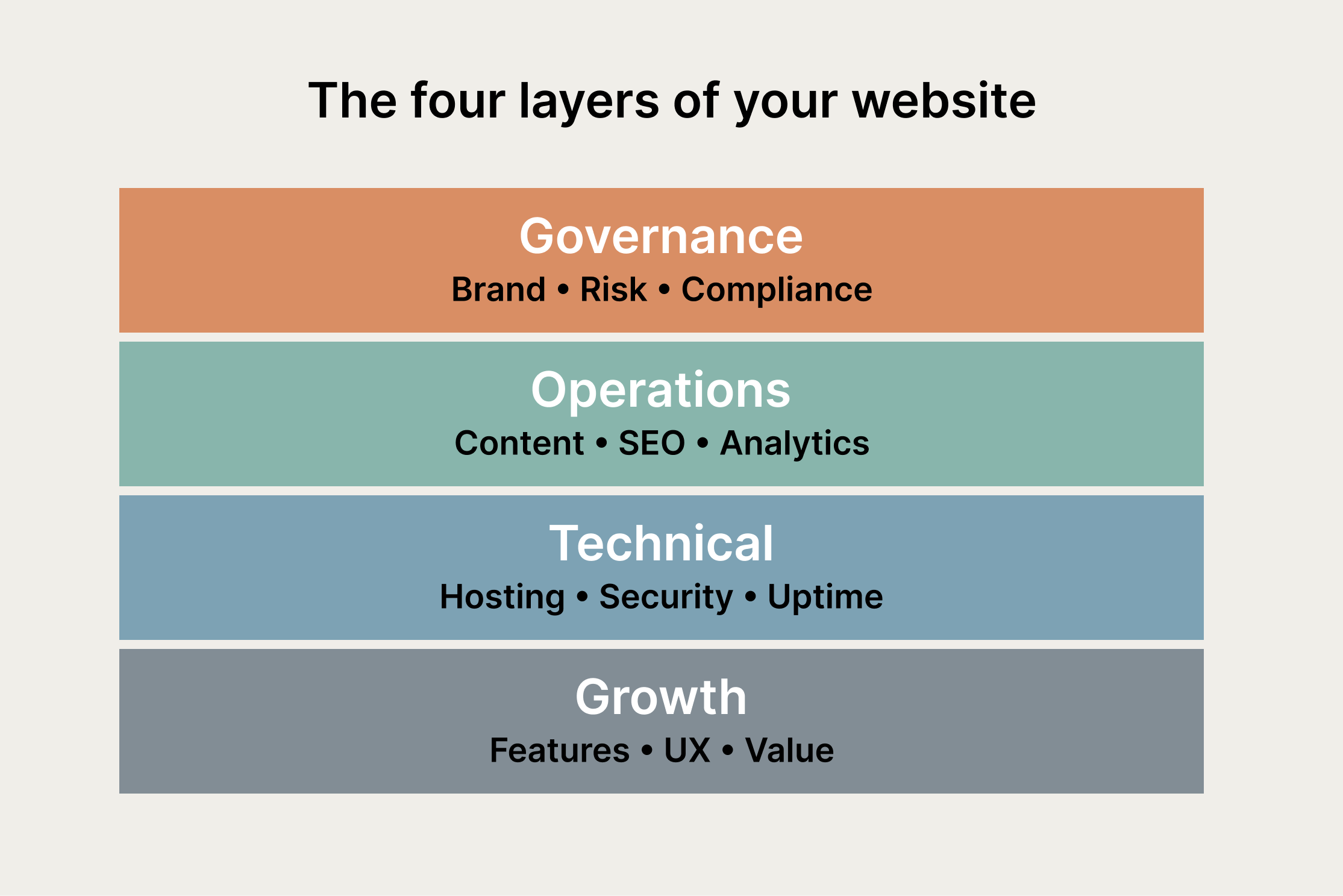
Once a website impacts revenue, reputation, or compliance, you must move from fixing problems to managing your website as a service, you need to define the four layers of your platform:
1. Governance (The Guardrails)
Focus: Brand, Risk, and Compliance.
The Question: “Are we GDPR-compliant with this new tracking pixel?” The ICO requires clear consent for non-essential cookies and tracking technologies under PECR (ICO – Cookies and similar technologies).
The Owner: Marketing Head or Legal.
2. Operations (The Engine)
Focus: Content, SEO, and Analytics.
The Question: “Why does the GA4 report conflict with the finance data?”
The Owner: Digital Manager.
3. Technical (The Foundation)
Focus: Hosting, Security, and Uptime.
The Question: “The site is down on a Saturday; who is on call?” For example, Microsoft Azure App Service offers uptime SLAs up to 99.99% depending on configuration (Microsoft Azure SLA).
The Owner: IT or an External 24/7 Support Agency.
4. Growth (The Future)
Focus: New Features, UX, and Value.
The Question: “Can we build a custom calculator for the Q3 campaign?”
The Owner: Product Owner or Dev Team.
Outcomes by role
When you manage a website as a service, the business sees measurable performance improvements across every department:
Marketing: Improved brand consistency and campaign agility by separating Governance from Growth.
Technology: Reduced technical debt and improved security.
Operations: Lowered operational risk through clear incident processes.
Finance: Predictable TCO (Total Cost of Ownership) and high availability, targeting an Azure-standard 99.99% SLA (Microsoft Azure SLA).
If you’re in charge of all four layers — but you don’t control budget, roadmap, vendor selection, or incident response — then you are operating without a clear mandate.
If you want more structure in your website operations, get in touch. I’m here to help.
Adam
UK-based. In person, where possible.