
The end of the click-slave era.
I founded Midday to offer practical, grounded support for people whose digital responsibilities have grown and become harder to manage.
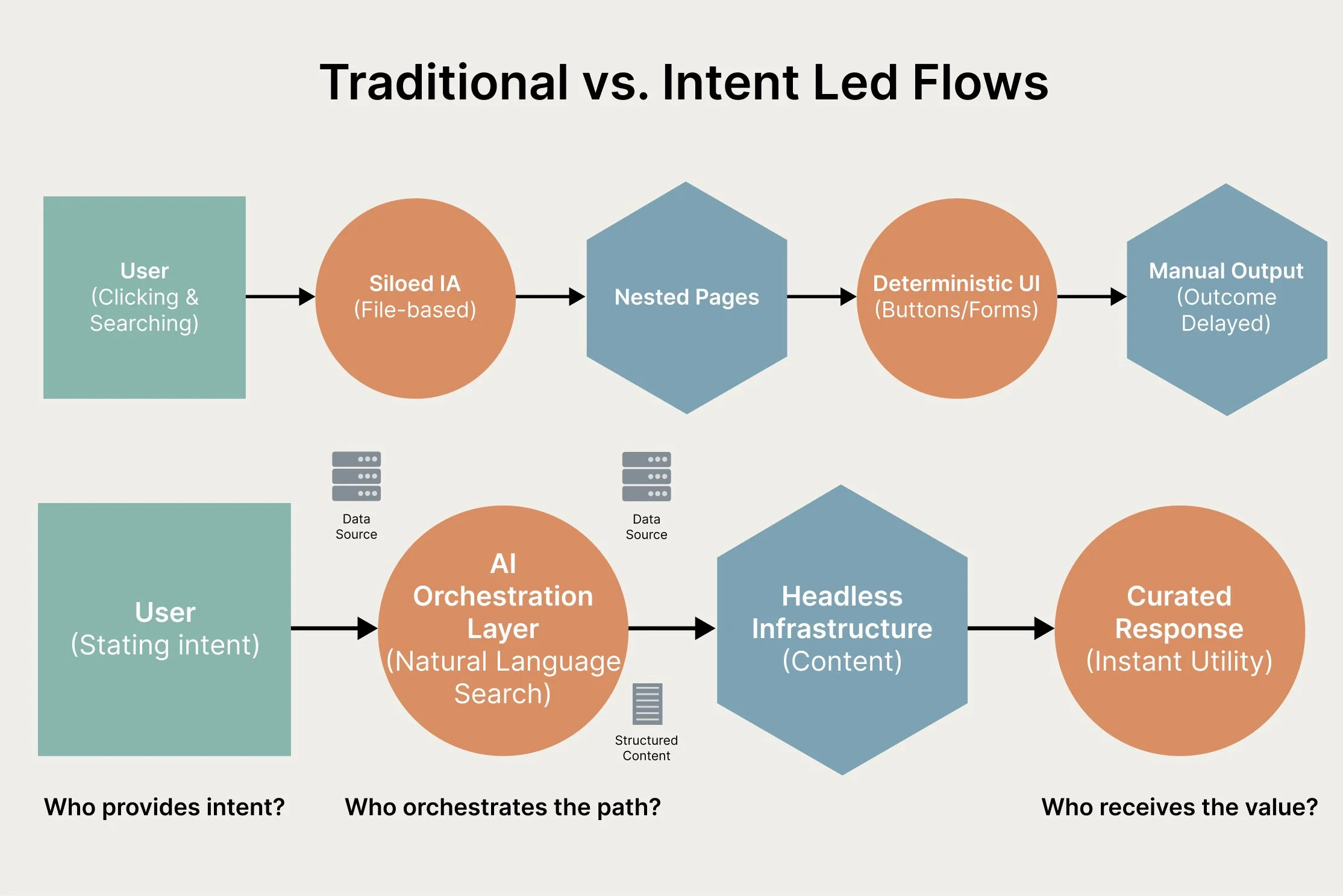
Traditional vs. Intent-Led Flows
Recently, I’ve been thinking about the direction of the human-machine web interface. For decades, we’ve treated the internet like a giant, poorly organised filing cabinet. Where ‘time on page’ is celebrated as a victory rather than a fundamental failure of design.
I’m now considering how people navigate websites. Rather than following the usual navigation (Home, Category, Service, and then CTA), users now require an orchestration layer, such as AI search, chat-based entry points and content that adapts to their needs in real time.
I’ve talked about personalisation and its limits for years. True personalisation has been possible only for companies with sufficient budget and data. That’s still the case, but we are moving from tracking a user’s history to capturing their immediate intent.
Most websites still follow the same 2005-era formula: pages, menus, clicks, forms, and funnels. They demand you learn their specific hierarchy just to find a single answer. While today’s sites look better and work faster, they continue to expect people to adapt to how machines work, rather than the other way around.
The shift we’re seeing isn’t just “AI search.” It could be the end of the traditional UI as we know it.
While AI has become an interface layer added to platforms and websites. New web solutions are being built from the ground up. UI still remains, but AI better connects what people want with how information is organised. Instead of searching, filtering and comparing, users simply ask. On your site, AI could complete tasks, support natural-language search and enable rapid interactions.
The new mandate for your team
So, what are the consequences for UX, design, and content teams?
User Experience: Design flows around jobs-to-be-done, not pages. If your UX designer is still talking about “user flows” through a five-page funnel, fire them. The new flow is Intent → Outcome.
Design: Interfaces should be brutally simple. The user is there to solve a problem. Visual design must serve the goal.
Content: Content must be structured as atomic units of information. It is no longer just about writing “copy”; it is about creating data that an AI can parse, reshape and deliver in the exact context the user requires.
The interface will act as a smart layer. Instead of making users click through everything, the system will search for them and give the best answer or next action.
While many teams use old methods, they recognise that change is happening. Their next website upgrade might be embedding natural language search.
Think of your future website like this:
the pages still exist,
the Information Architecture still exists,
but they are no longer the primary interface.
The interface will act as a smart layer that searches the site for users, rather than requiring them to find things themselves. The system handles this for users and then shows the most relevant answer or summary.
Traditional website
User → Navigation → Pages → Content
Future hybrid website
User → Intent → Orchestration layer → Pages → Curated response
The future website keeps pages as infrastructure and, in addition to navigation as the primary interface, adds intent-led natural-language search and structured content.
If you’re thinking about what this means for your site, ask if users can express what they want in their own words. Does the site adapt based on who they are and what they do? Does it feel more similar to a conversation? Does the interface help people make decisions?
Redesigning how people interact with your website means designing websites that:
Understand intent
Use structure intelligently
Adapt in real time
Communicate naturally
Guide users toward outcomes with minimal effort
Talk to me. Don’t make me click.