
Do you really need another tool?
A new tool won’t fix a messy process.

I set up Midday to offer practical, grounded support for people whose digital responsibilities have grown and become harder to manage.
If you’re feeling pressure to update your tech stack or switch tools because your current setup isn’t quite working, this post is for you.
The push to modernise is a constant for those involved in digital work. It shows up in emails, meetings, and moments when a broken process or lack of technology adoption is blamed on outdated software. Maybe a team member shares a video of a new AI assistant or task management app, thinking it’s helpful.
Last week, I discussed how you might have become the default decision-maker for digital work. Today, let’s talk about the urge to solve problems by adding another tool to your workflow.
It’s so tempting to look at alternative software options. We’re told the right tool will magically make everything run smoothly.
But this approach is a distraction. Layering a shiny new tool onto a messy process doesn’t fix the mess.
Most of the time, new tools are added to your tech stack for good reason.
The promise of new features
It’s easy to hope a new app will finally organise your data or fix problems your current setup can’t handle. But research from Harvard Business Review shows that digital initiatives fail when organisations prioritise tools over how work is actually designed and decisions are made.
Delegating tough choices
Sometimes, it’s tempting to let software make decisions so you don’t have to spend energy on every detail. Accenture-backed research published in HBR finds that many digital transformations stall because leadership fails to clarify ownership, priorities, and outcomes before introducing technology.
Fear of missing out (FOMO)
There’s also the sense that you’re falling behind if you aren’t investing in the latest technology. Waves of tech adoption are often driven more by competitive anxiety than by proven productivity gains—especially when organisational design remains the same.
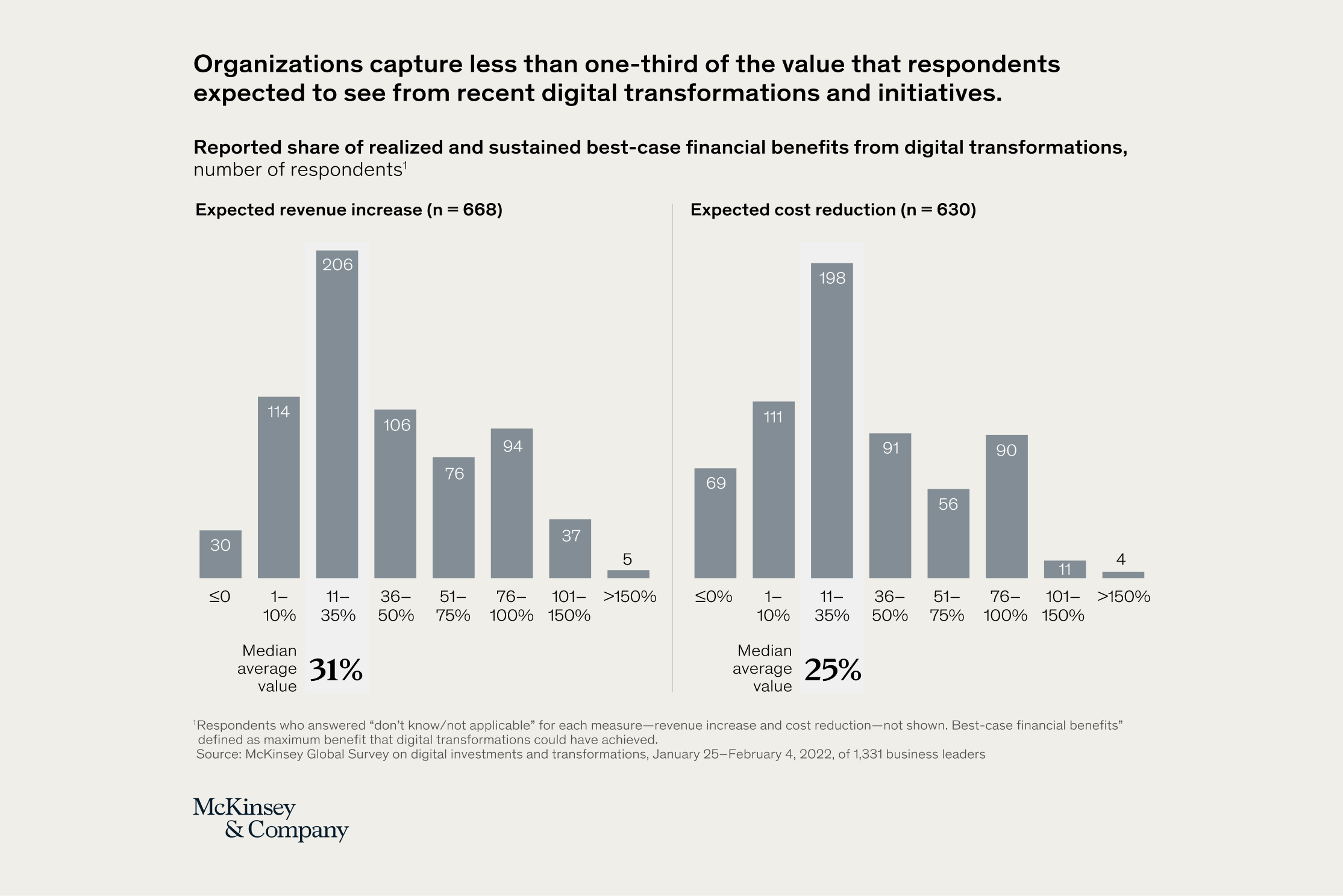
Each tool you add requires time and effort to set up and manage. McKinsey estimates that many organisations capture only a fraction of the value they expect from digital investments because complexity increases faster than productivity.
If you’re already feeling stretched, adding one more app often adds to your digital workload rather than reducing it.
Many digital problems aren’t caused by outdated software at all.
Harvard Business Review consistently finds that digital initiatives fail due to unclear processes, decision rights, and ownership — not because the tools themselves are inadequate.
McKinsey makes the same point more bluntly: digitising broken processes simply makes those problems faster and more expensive. Their guidance is to start with the problem, not the technology.
If your process is unclear, a new tool won’t help and may even make unwinding later more difficult.
The before-you-buy questions
Before you consider a new tool, check if you can answer these four questions.
If you can’t answer, the tool is just a distraction.
Before adding new software, pause and evaluate your process first.
Friction - Is the real bottleneck a lack of features, or a lack of a clear, agreed process?
Attention - Who will own this tool day to day?
Do they genuinely have the time and headspace to manage it properly?
Outcome - Will this tool directly move a business metric that matters — or will it mainly change how we report or visualise existing work?
Exit strategy - If we turn this tool off in six months, what breaks?
What work becomes impossible, slower, or unclear?
Next time you feel the urge to “fix” a digital problem with a new subscription, stop and review your current process using the worksheet below before committing.
Try to fix the problem first. Strip the process back to its simplest form in a basic document such as a spreadsheet. If it does not work there, it will not work in a £500-a-month platform either.
Progress often comes from knowing what not to do. This week, that might mean saying ‘no’ to a demo.
Ask yourself:
Which tool in your stack currently creates more work than it saves?
Are you buying a solution for a technical problem or a management one?
What would happen if you did nothing for another month?
I hope this helps.
Adam
UK-based. In person, where possible.
Sources & further reading
Harvard Business Review — Digital transformation is not about technology
https://hbr.org/2019/03/digital-transformation-is-not-about-technologyHarvard Business Review (Accenture research) — The two big reasons digital transformations fail
https://hbr.org/2019/10/the-two-big-reasons-that-digital-transformations-failMcKinsey & Company — Start with the problem, not the technology
https://www.mckinsey.com/capabilities/strategy-and-corporate-finance/our-insights/in-digital-and-ai-transformations-start-with-the-problem-not-the-technologyMcKinsey & Company — Three new mandates for capturing digital value
https://www.mckinsey.com/capabilities/tech-and-ai/our-insights/three-new-mandates-for-capturing-a-digital-transformations-full-value